

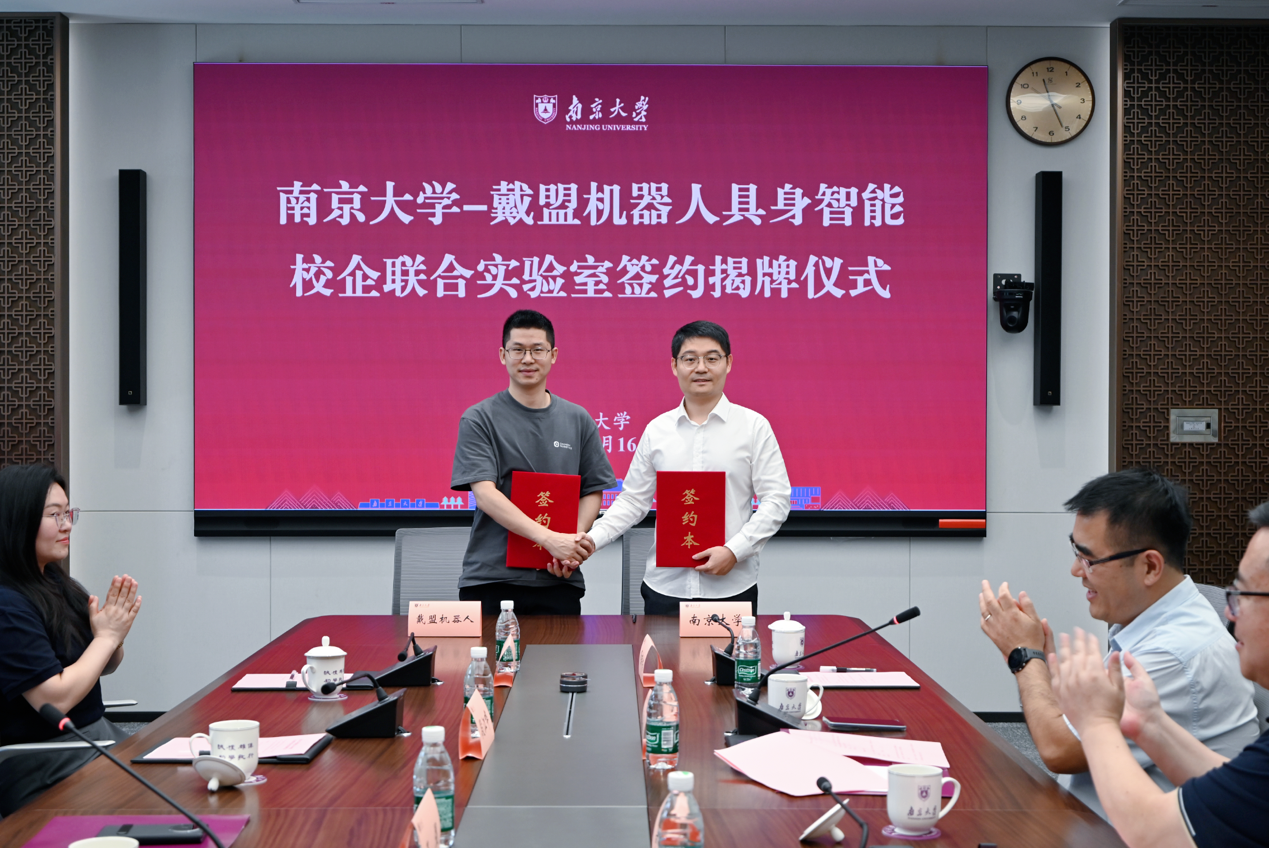
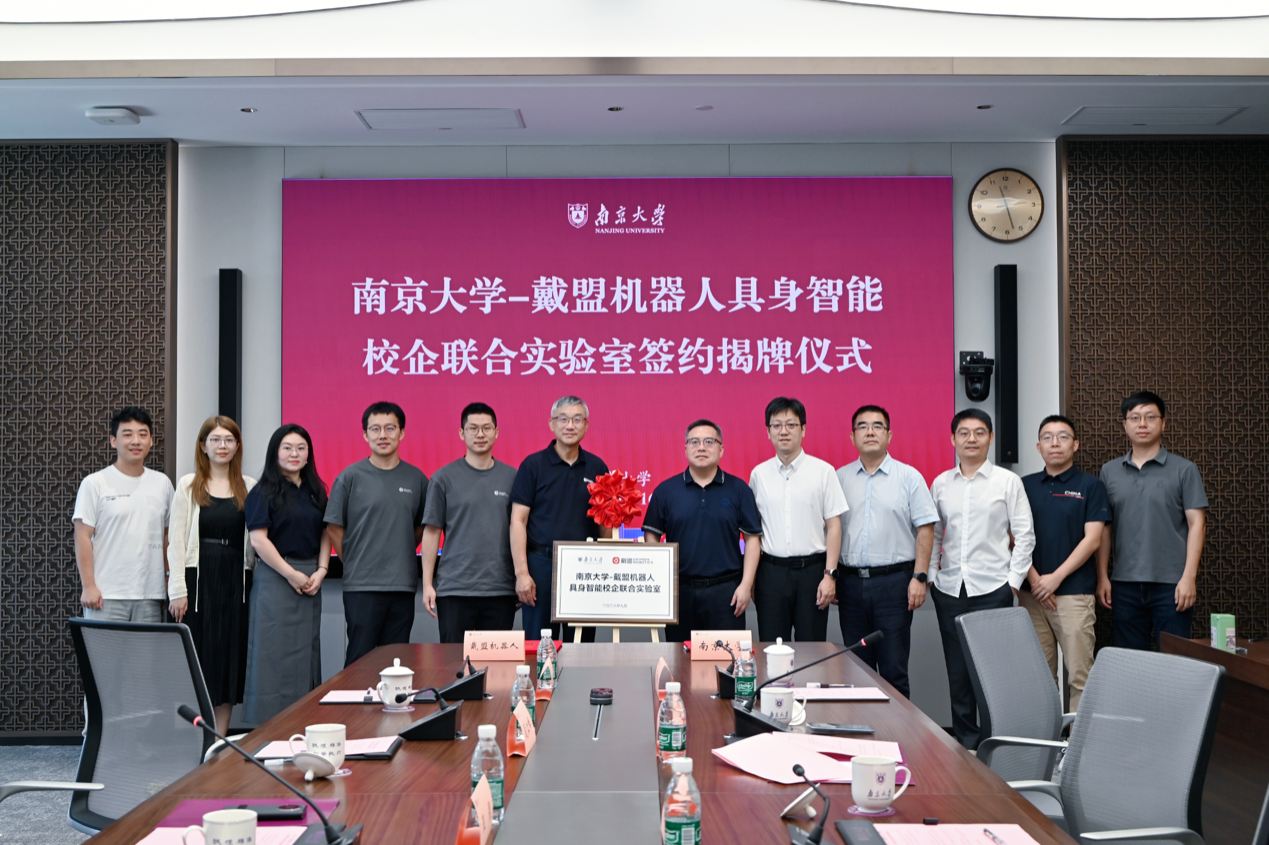
On September 16, 2026, the "Nanjing University–Daimon Robotics Joint Laboratory for Embodied Intelligence" was officially unveiled. Attendees at the signing and unveiling ceremony included Wang Yu, Co-founder of Daimon (Shenzhen) Robotics Technology Co., Ltd. and Dean of the School of Advanced Engineering at Great Bay University; Duan Jianghua, CEO of Daimon (Shenzhen) Robotics Technology Co., Ltd.; Gao Yang, Secretary of the Party Committee and Executive Dean of the School of Intelligence Science and Technology at Nanjing University; and Zhu Weiwei, Deputy Director of the Office of Science and Technology of Nanjing University and Director of the Office of the Science and Technology Institute at Suzhou Campus, among other representatives from both the university and the company. The ceremony was moderated by Shan Caifeng, Associate Dean of the School of Intelligence Science and Technology at Nanjing University.
As the first embodied intelligence laboratory officially unveiled at the Suzhou Campus, the joint laboratory will build an integrated innovation system for industry-university-research-application collaboration oriented toward frontier physical intelligence. Leveraging Nanjing University's comprehensive strengths in high-level talent, fundamental research, interdisciplinary integration, and technological innovation, combined with Daimon (Shenzhen) Robotics Technology Co., Ltd.'s industrial layout and engineering capabilities in robotics, tactile perception, and physical intelligence, the laboratory will serve as a platform connecting original academic innovation with real-world industrial needs, contributing research outcomes and cultivating professional talent for China's embodied intelligence development.

As artificial intelligence accelerates from the digital realm into the physical world, robots need to possess physical interaction capabilities—using physical feedback to understand object properties, predict contact changes, and perform fine manipulation. Although Vision-Language-Action (VLA) models have shown strong potential, they still face challenges in contact-rich manipulation tasks such as assembly, insertion, wiping, and grasping fragile objects, including insufficient physical cognition, difficulty in judging contact states, and delayed action correction. Tactile sensing can directly provide rich physical feedback such as contact force, deformation, friction, and slip, making it a key modality for developing dexterous robotic manipulation.
Against this industry backdrop, the joint laboratory will focus on three interconnected research thrusts: tactile foundation models, VLA models, and tactile manipulation models. In terms of tactile foundation models, the laboratory aims to build multimodal datasets and develop tactile representation models and tactile physical reasoning models, endowing models with an understanding of physical properties such as hardness, roughness, and deformation. In terms of VLA multimodal models, the laboratory attempts to introduce 3D prior knowledge and optimize the action expert module to enhance the model's perception and complex manipulation capabilities in 3D space. On this basis, the laboratory further integrates high-resolution, high-frequency tactile information to build a Tactile-Vision-Language-Action (TVLA) multimodal manipulation model and a Tactile World Action Model (TWAM), incorporating the tactile modality into manipulation models to enhance robots' physical interaction capabilities and advance the development and deployment of physical intelligence.
The joint laboratory deeply integrates the strengths of both parties. As a century-old prestigious university with global renown, Nanjing University stands at the pinnacle of Chinese higher education, with profound research heritage and a consistent presence at the forefront of national scientific and technological innovation. In 2018, it was the first among C9 League universities to establish a School of Artificial Intelligence, and in 2022, it founded the School of Intelligence Science and Technology, bridging fundamental research and industrial application while continuously cultivating top-tier innovative talent for the new round of technological revolution and industrial transformation. Since its establishment, the School of Intelligence Science and Technology has developed a solid research foundation and a high-caliber talent team in areas including VLA multimodal models, world action models, tactile intelligence, reinforcement learning, and 3D vision.
Daimon Robotics, as a representative enterprise in China's embodied intelligence sector, is committed to building a full-chain physical AI capability system integrating tactile sensing, data, and models—with tactile sensing as the entry point, data as the fuel, and models as the core—to endow robots with genuine physical intelligence. Incubated from the robotics research team at The Hong Kong University of Science and Technology, Daimon's core products include tactile-anchored world models, vision-tactile-language-action (VTLA) multimodal data acquisition systems, and multi-dimensional high-resolution high-frequency visuotactile sensors, providing critical support for stable robotic manipulation in real contact and complex environments.
At present, the joint laboratory has already achieved initial results. Addressing the issue that current models rely on visual appearance and cannot perform physical reasoning based on real tactile evidence, the laboratory has built a dataset containing 1 million sets of synchronized tactile data across 4 types of tactile sensors, and proposed a tactile reinforcement learning method to endow models with tactile reasoning capabilities. The model Touch-R1 achieved the best results across nine core tactile reasoning metrics, including object attribute recognition, sequential reasoning, and cross-sensor consistency, with a comprehensive score of 60.1—outperforming the current strongest tactile-specific model SToLa by 12.6 points and GPT-4o by 24.7 points. This work has been accepted by NeurIPS 2026. Another work, UniTacVLA, focuses on tactile manipulation models. By constructing a unified latent space and combining tactile chain-of-thought with a coarse-to-fine tactile prediction mechanism, it infers future physical interaction states. Through a hybrid action-tactile controller, it achieves hierarchical coordination between low-frequency task planning and high-frequency tactile correction, endowing robots with instantaneous control and real-time adjustment capabilities. The model UniTacVLA achieved an average success rate of 64.0% (under undisturbed conditions) and 53% (under disturbed conditions) in contact-rich tasks such as adjustment, insertion, wiping, and assembly, significantly outperforming the mainstream manipulation model π0.5, which scored 26% and 6%, respectively.
Talent cultivation is also an important mission of the joint laboratory. The two parties already have a solid foundation for talent exchange, and will further advance joint graduate training, technical personnel training, and regular academic exchanges, supporting students in exploring interdisciplinary areas spanning artificial intelligence, robotics, control science, and tactile sensing. This enables young talents to both delve into fundamental scientific questions and participate in the development and validation of real robotic systems, developing the ability to solve complex problems through interdisciplinary collaboration.
The establishment of the Embodied Intelligence Laboratory at Nanjing University Suzhou Campus is not only a key path for the School of Intelligence Science and Technology to proactively engage with advanced industries and promote the translation of research outcomes, but also an important measure for the Suzhou Campus to improve its research layout in artificial intelligence and robotics and deepen industry-university-research collaborative innovation. It is also an important practice for Nanjing University in implementing the integrated development of education, science and technology, and talent. In the future, the joint laboratory will orient itself toward national strategic needs and the academic frontiers of embodied intelligence, working together to open up the translation channel between frontier research and industrial application, continuously injecting new momentum into the high-quality development of the embodied intelligence industry!
