

As LLMs' coding capabilities advance, generating game prototypes from natural language is emerging as a key direction in intelligent software development. Yet most existing methods only produce a first runnable version, leaving out requirement clarification, art asset creation, playtesting, quality acceptance, and iteration. Moreover, traditional game engines are built for human developers—engineering states are scattered across GUIs, configs, and binary assets—while games run in real time at high frame rates, making it hard for general coding agents to read projects, control gameplay, and iteratively refine based on playtest feedback.To tackle this, PRLab at Nanjing University, S-Lab at NTU Singapore, and Liblib.ai jointly propose VibeGame, an agent framework for game development. Hu Wenbo, Li Ken, and Wei Jiazhe are co-first authors; Si Chenyang is the corresponding author. The team defines the task as "Prompt-to-Game Development"—unlike text-to-game methods that deliver a one-shot result, VibeGame takes a natural language description and an optional concept image, and covers requirement alignment, game design, code and art development, automated playtesting, and final acceptance, delivering a runnable 2D game project that users can further modify via natural language. VibeGame comprises an AI-Native game engine for agents, an adversarial multi-agent team, and a training-free experience reuse mechanism.
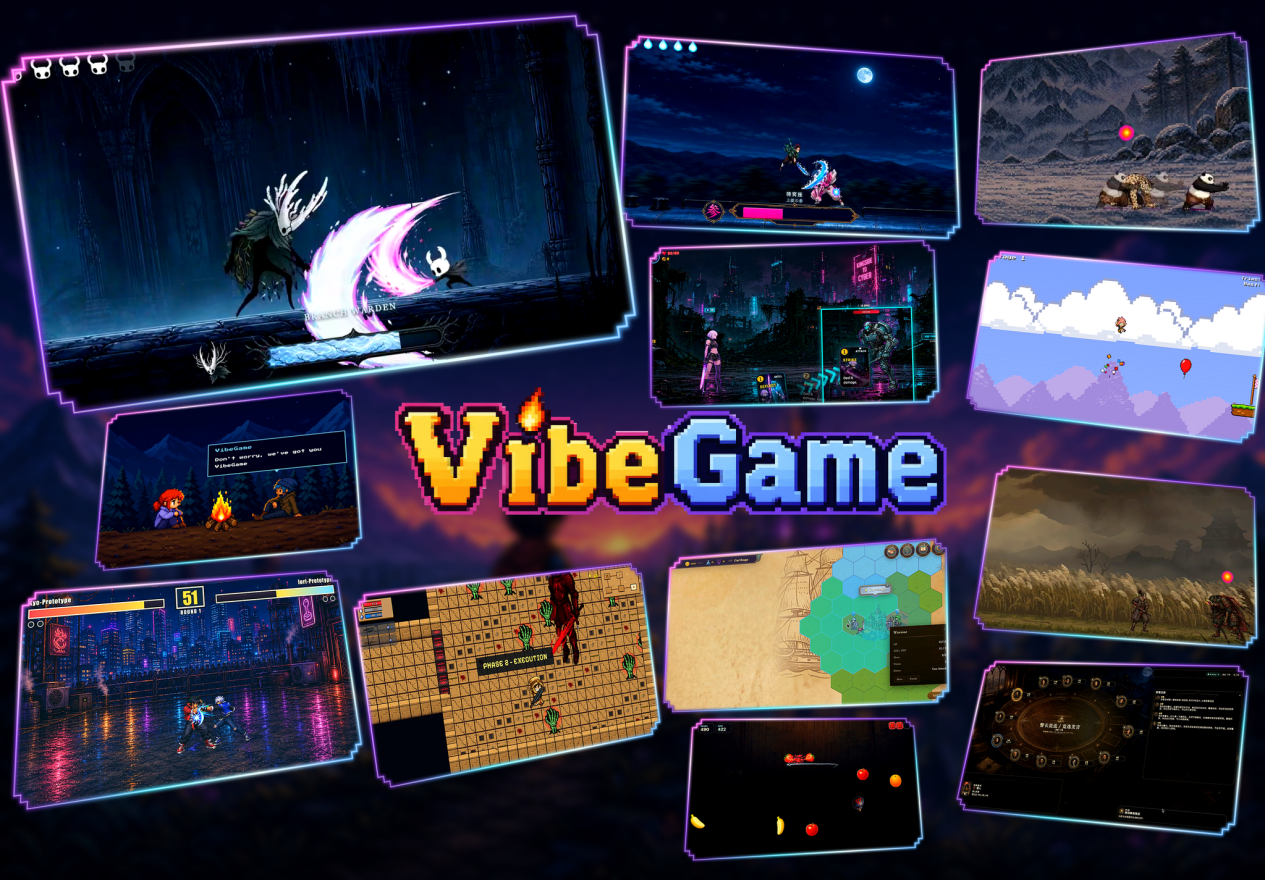
Figure 1: Representative 2D game prototypes from VibeGame, showing diverse visual styles and gameplay types.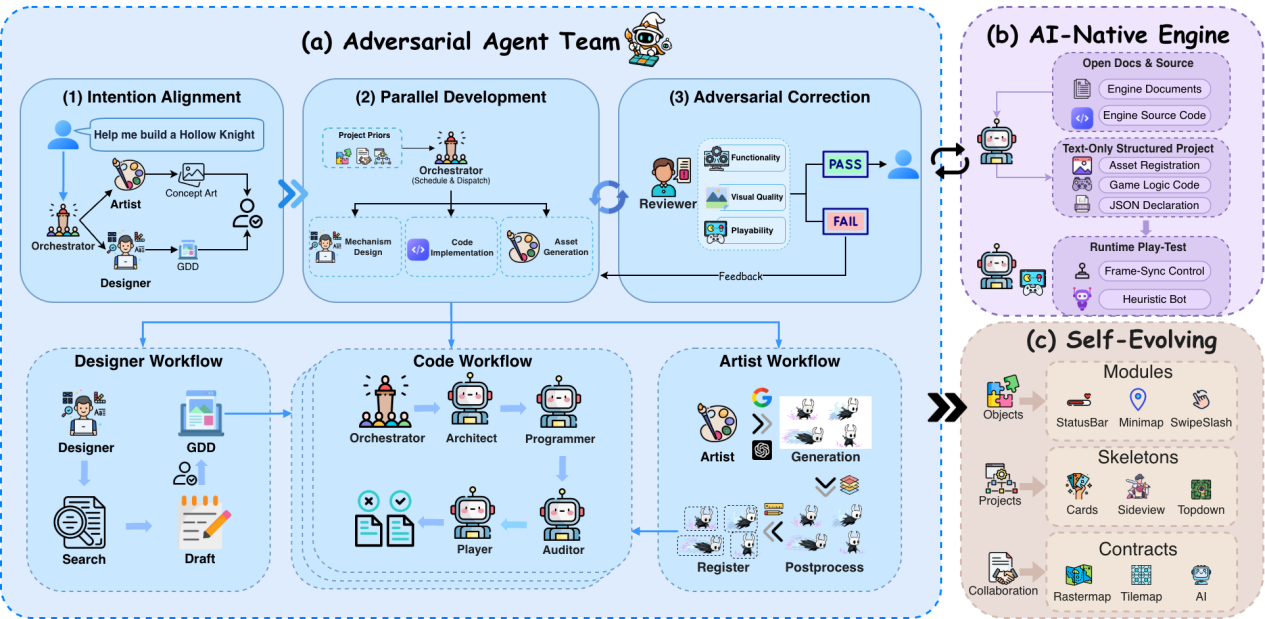
Figure 2: Overview of the VibeGame framework. User requirements are processed through intent alignment, parallel development, and adversarial revision to produce a game project. The AI-Native engine enables automated playtesting and validation, with accepted results distilled into reusable assets.
Work 1: Building an AI-Native Game Engine for Agents
Existing engines scatter project state across editor panels, config files, and binary assets, preventing agents from gaining a unified view. To tackle this, the team built an agent-oriented engine on top of Phaser. Scenes, animations, collisions, and numeric values are stored as typed textual JSON, letting agents edit games like code and catch errors such as broken references before runtime. The engine supports pausing, frame-by-frame stepping, injecting actions like jump and attack, and reading states or comparing screenshots—turning a high-speed real-time system into something agents can inspect at their own pace. The full engine source is open with the project, so agents can trace implementation when docs are lacking or versions mismatch. Together, these designs give 2D game projects a unified, readable, writable, and verifiable interface for agents.
Work 2: An Adversarial Multi-Agent Loop for Development and Verification
A single agent handling both generation and evaluation tends to miss issues like visual quality, input responsiveness, and requirement consistency. To address this, VibeGame forms an adversarial team of eight roles—producer, designer, artist, architect, programmer, auditor, playtester, and acceptance reviewer—following the principle of separating producers from verifiers. "Adversarial" here means questioning and correction across development vs. auditing, implementation vs. playtesting, and delivery vs. acceptance. The producer clarifies user intent, the designer drafts the design document, and the artist creates concept art aligned with the user. Coding, art, and design tasks then run in parallel. The auditor verifies implementation against the design doc, while the playtester uses the engine's action interface for automated playtesting. Finally, the acceptance reviewer evaluates functionality, visuals, and playability. Failed items return to development with specific reasons and are iterated until acceptance criteria are met or termination conditions are reached.
Work 3: Enabling Training-Free Experience Accumulation and Reuse
To keep project experience from being lost after one delivery, VibeGame distills accepted outputs into three reusable assets: a game skeleton preserving structure and parameters, a generic module containing inspection logic, and a collaboration contract describing how roles work together and what they deliver. When a new project begins, the system retrieves relevant assets as a starting point and re-adapts and verifies them under the new requirements. This process does not update the base model's parameters; rather, it supports future development by accumulating project history, codebases, and collaboration experience.
System Capabilities Demonstration
In practice, VibeGame can build design, code, and art from scratch based on a brief gameplay description, or align characters, scenes, and colors using a concept image. After the first delivery, users can keep requesting changes: the system reads the existing JSON project, code, runtime state, and screenshots, parses the request, locates affected code and assets, and applies local fixes or re-enters the development loop. Results again go through automated playtesting and acceptance, with failed items returned with reasons. This lets the system reskin an entire project, transform gameplay mechanics, or adjust character relationships without regenerating from scratch each time.
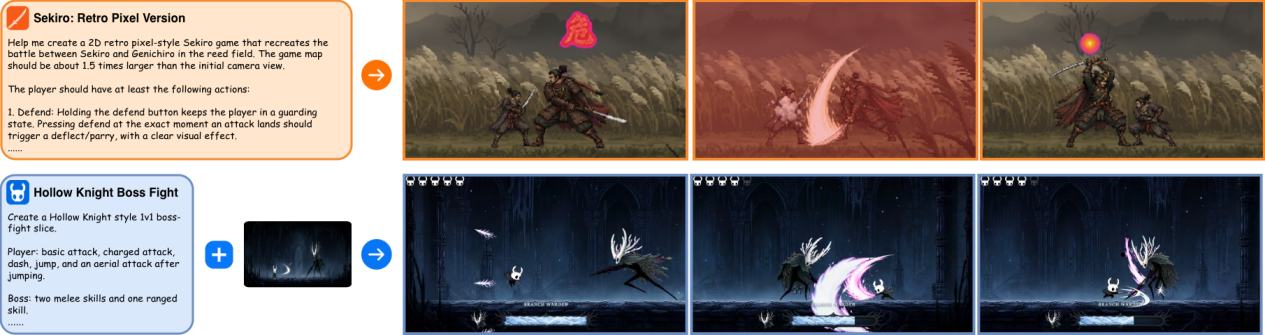
Figure 3: VibeGame's game creation capabilities. Top: generating a playable 2D game from a text description; Bottom: aligning characters, scenes, and visual style using a concept image. All outputs are runnable game projects.
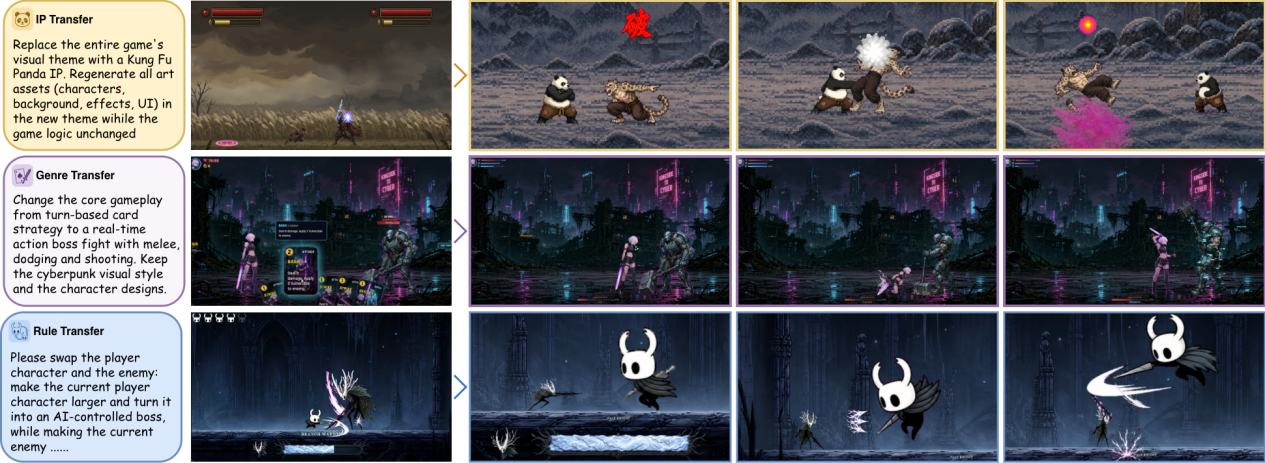
Figure 4: VibeGame's game editing capabilities. Top: migrating the overall visual style while preserving core gameplay; Bottom: changing the gameplay type in an existing project and re-validating through playtesting.
System Demonstration
Video 1: VibeGame System Demonstration (1 min 24 sec)
VibeGame links agent-oriented project representation, executable playtesting, adversarial acceptance, and experience reuse into a closed loop for creating 2D game prototypes and continuously modifying existing projects.
