

On April 30, Tenure-Track Associate Professor Tianpei Yang of our school invited Chenjia Bai, a Research Scientist at the AI Research Institute of China Telecom, and Long Wu, Head of the Manipulation Algorithm Team at Magic Atom Robotics Technology Co., Ltd., to deliver an embodied AI-themed academic report at Classroom B207, Sujiao Building. The report focused on cutting-edge topics such as vision-action-language models, industrial vision-based grasping, and the practical deployment of embodied AI. The session was moderated by Tianpei Yang.
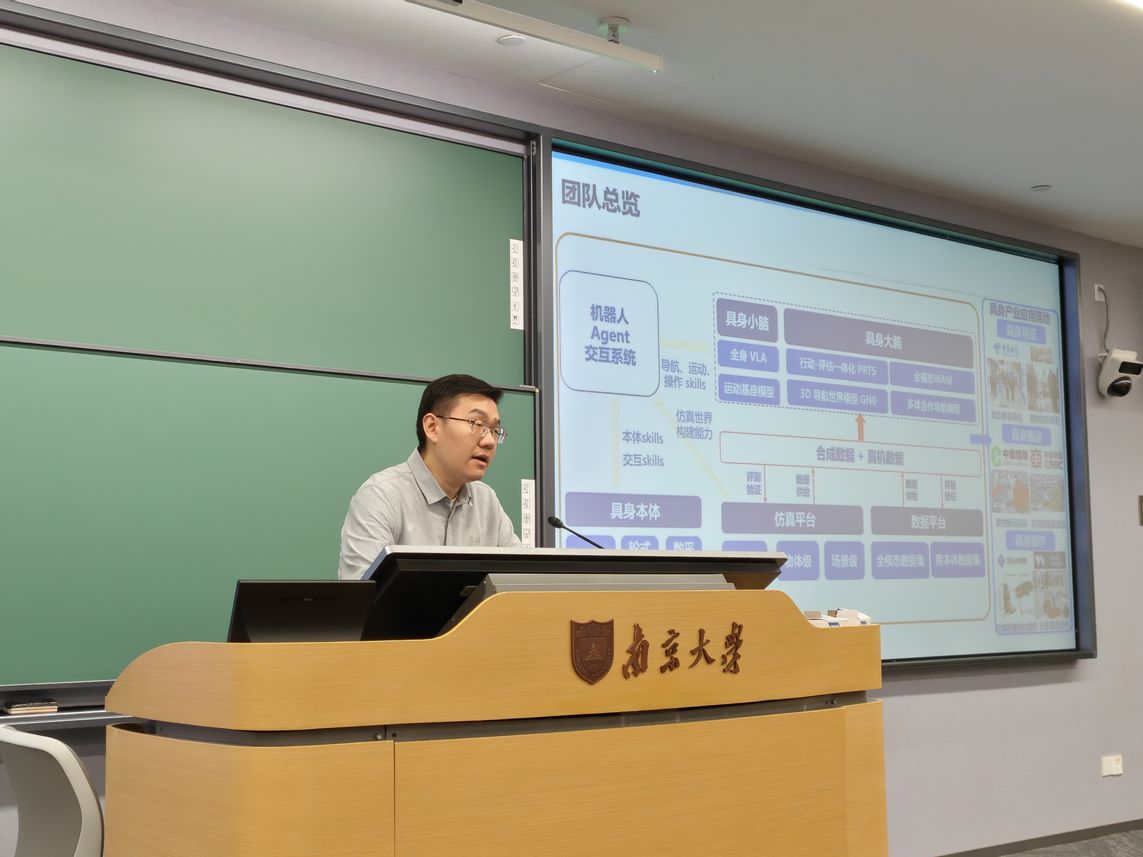
Chenjia Bai shared his cutting-edge research titled PRTS: Contrastive Reinforcement Learning-Driven Large-Scale Vision-Action-Language Model. He pointed out that representation learning is a core challenge in robotic learning. Although vision-language-action models have made significant progress, existing paradigms still struggle to fully capture the temporal structure of goal achievement in robot trajectory learning. During his talk, he highlighted PRTS, a novel foundation model for VLA, and explained its key designs introduced during pre-training, including goal-conditioned reinforcement learning, language-conditioned contrastive representation learning, and implicit dense value supervision. Experimental results demonstrate that PRTS achieves excellent performance in both simulation and real-world environments, with particularly notable advantages in long-horizon manipulation and fine-grained contact-rich tasks.
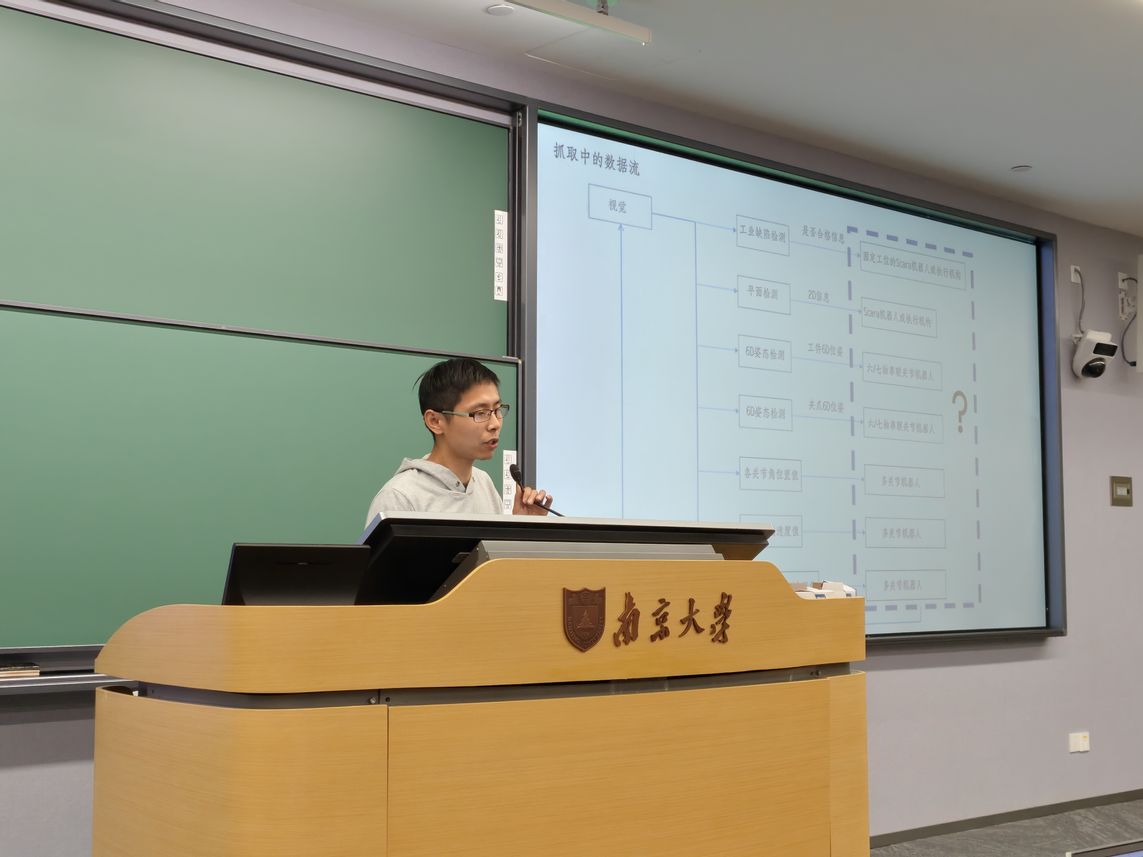
Long Wu, in his talk titled Embodied AI in Industrial Practice: A Slice Perspective on Vision-Based Grasping Scenarios, started from the typical industrial scenario of vision-based grasping and systematically introduced key issues in the industrial deployment of embodied AI robots. His presentation covered robot arm grasping, visual servoing, model-based methods, progress assessment of product deployment, the evolution roadmap of grasping systems, and end-to-end technical practices. Drawing on his research and development experience in humanoid robots, industrial vision guidance, and robot learning, he shared multiple practical case studies and analyzed the current challenges still facing grasping problems in humanoid robotics.
Faculty and students in attendance actively engaged in discussions on topics such as embodied AI model training, long-horizon robotic manipulation, the deployment of industrial vision-based grasping systems, and humanoid robot operation algorithms. The two experts addressed each question based on their own research and industrial practice, leading to frequent interactions and a lively discussion throughout the session.
