

Recently, at the RIVA Cervical Cytology Challenge (Hospital Rivadavia Cervical Cytology Challenge) held during the International Symposium on Biomedical Imaging (ISBI) 2026, a premier conference in biomedical imaging, Kong Yan, a Ph.D. student of the Class of 2025 from our school (supervised by Professor Shan Caifeng and Tenure-Track Associate Professor Fang Yuqi), stood out among over 150 competing teams worldwide, winning first place (champion) in Track B and second place (runner-up) in Track A.
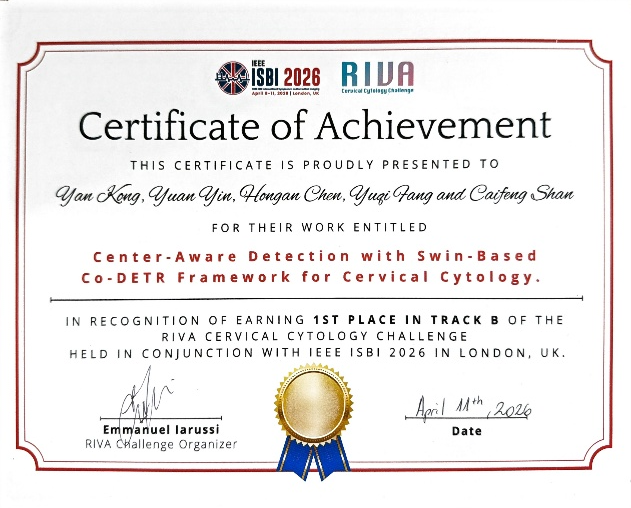
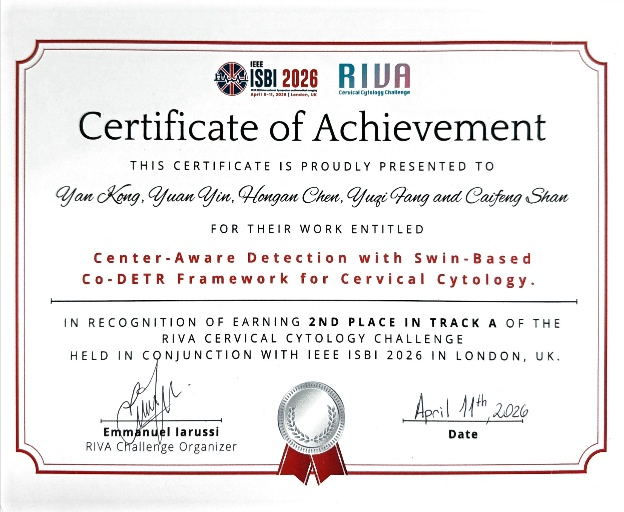
This challenge focuses on leveraging artificial intelligence to achieve automated analysis and interpretation of cervical exfoliated cell cytology slides. Track B required cell detection on complex backgrounds, while Track A added Bethesda classification requirements on top of detection. Addressing the challenges posed by dense distribution of cervical cells and fixed bounding box sizes, the team proposed a Co-DINO object detection framework based on center-awareness and a Swin-Large backbone network. The framework incorporates three core techniques: a center-preserving data augmentation strategy, geometric bounding box optimization, and track-specific loss fine-tuning. These effectively overcame difficulties such as cell morphological truncation and localization jitter, achieving leading results in cell detection accuracy and recall.
The team's technical paper, titled Center-Aware Detection with Swin-based Co-DETR Framework for Cervical Cytology, was also accepted by ISBI 2026, and the team has been invited to present it as an oral presentation at the conference in London, UK.
Introduction to the Supervisor(s)
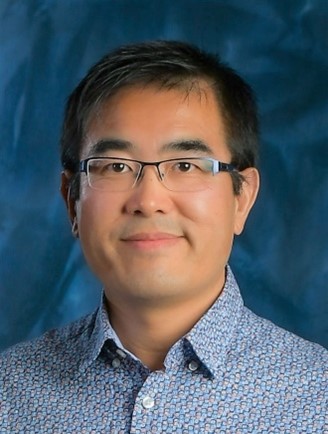
Caifeng Shan is a Professor, Ph.D. Supervisor, and a national-level leading talent.
He currently serves as the Associate Dean of the School of Intelligence Science and Technology, Nanjing University, and the Associate Dean of the NJU-China Mobile Joint Research Institute. He received his Bachelor's degree from the University of Science and Technology of China in 2001, his Master's degree from the Institute of Automation, Chinese Academy of Sciences in 2004, and his Ph.D. from the University of London, UK, in 2007. Subsequently, he worked for over a decade at Philips Research in the Netherlands as a Senior Scientist and Team Leader, while also holding a research position at Eindhoven University of Technology. His research primarily focuses on computer vision, pattern recognition, and medical image computing. He has led multiple EU Horizon 2020 projects, National Natural Science Foundation of China (NSFC) Original Exploration projects, and MIIT Open Competition projects. He has published over 170 papers (with more than 10,000 citations) and holds over 100 granted patents across various countries (including over 60 patents in the US, Europe, and Japan). He has received the Philips Invention Award and has been recognized as a World's Top 2% Most Influential Scientist and a Philips High Potential talent. He has served as an editorial board member or guest editor for more than 10 international journals, including several IEEE Transactions.
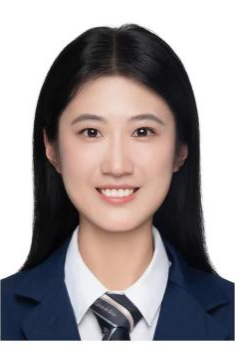
Fang Yuqi is a Tenure-Track Associate Professor, Specially Appointed Researcher, and Ph.D. Supervisor at the School of Intelligence Science and Technology, Nanjing University, and a national-level young talent. She received her Ph.D. degree from The Chinese University of Hong Kong in 2020. From 2021 to 2024, she worked as a Postdoctoral Researcher at the University of North Carolina at Chapel Hill, USA. She joined the School of Intelligence Science and Technology, Nanjing University, in May 2024. Her research interests lie in medical artificial intelligence, including multimodal medical data analysis, medical foundation models, brain-computer interfaces, and drug recommendation. She has published 35 research papers in high-impact journals and conferences in the field of medical AI, including Medical Image Analysis, NeuroImage, and MICCAI. Her papers have been recognized as ESI Highly Cited, and her work has been cited by numerous academicians and IEEE/ACM/AIMBE/IAPR/MICCAI Fellows both domestically and internationally. She serves as the Principal Investigator for projects including the NSFC Young Scientists Program, the Fundamental Research Funds for the Central Universities (International Collaboration Project), and the Nanjing University AI & AI for Science Special Project. She won the championship at the 40th EMBC International Brain-Computer Interface Hackathon (BR41N.IO BCI Hackathon). She serves as a committee member of the Youth Symposium on Medical Image Computing (YMIC) and is a regular reviewer for leading international journals and conferences, including TPAMI, TMI, MedIA, MICCAI, TNNLS, TIP, NeurIPS, and AAAI.
